This is a joyful moment, my first article. I feel before I begin, that it is only right that I tell you, the readers, about how I arrived at this point. In short, it began when I had a wonderful meeting with a dear friend who I have a spirit connection with. She is always cheering me forward. She asked me a direct question.
“How is theater viewed in the American Indian community?”
Then without blinking an eye she says, “Write me a article about it, and we will share it.” That is how it all began.
Before sharing the American Indian perspective on theater, I would like to state clearly that I am not an expert on American Indian culture and theater, nor do I speak for all tribal communities. American Indian culture does not live in a vacuum, and the culture is not monolithic. There are many facets to American Indian culture and how it views storytelling and dramatic performance. Let’s journey back in time by looking at the history of theater. Why was theater created, who was it created for, and for what overall purpose did it serve?
Before there was a name for theater there was ancient storytelling around fires, in councils, and in communities describing certain events that happened. This form of performance has been taking place since humans could communicate. Communication happens by using signs, symbols, dance, pantomime movements, songs, and physical gestures. This was a common practice because sometimes languages were different, and hard to understand across groups of people. Human interaction or connection describing events, things seen in life, places traveled, and things encountered; are described in basic forms of pantomime movement. This actual event could be played out in front of an audience.
Ancient forms of theater were used to channel feelings, and healing rituals by telling stories using nonverbal actions, to share a certain narrative, change a perspective or influence future actions and thoughts. It is deeply rooted in ceremony and ritual. Most traditional ancient cultures across the globe still view and practice the traditional forms of theater and storytelling. For example, William Shakespeare, who some referred to as a magician or medium because of his ability to write using ancient language said the writings had a unique ability to describe and cover subject matters that had yet to happen. These plays, sonnets and stories are just as relevant now in the 21st Century as when he wrote them back so many years ago. One could say through theater he offered us a map to live life better as society.
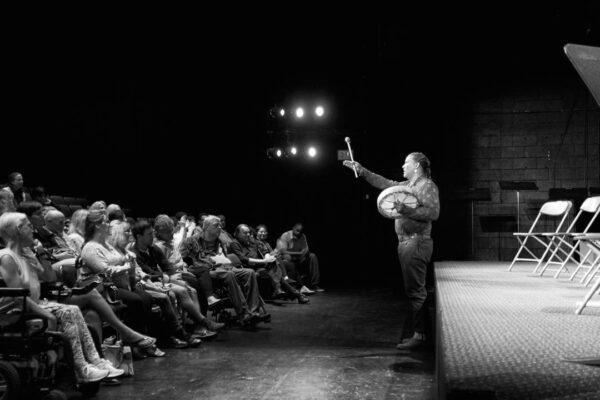
American Indian cultures and Indigenous Peoples all over the world, have a long ancient storytelling practice. It is informative, descriptive, and educational. I have personally found that even though American Indians have continued to practice storytelling it has faced challenges of being diluted over time, due to assimilation and the erasure of cultural traditions. In some extreme cases, it is not practiced at all. There was a time when actions of daily life had a song and a story to support it. There has been some rebuilding and reclaiming of ancient storytelling practices over the last 75 years. The practice of storytelling is an important part of a human life’s experience, and it helps by passing along oral traditional knowledge and connection to future generations.
American Indians use storytelling foundational teachings that fall right in line with theater arts; those teachings are rooted in respect, reciprocity, responsibility, and relationships. This is how American Indians who walk a traditional road approach any form of creative activity. Specifically in theater, this approach is to have the actors embody the written words giving them life-so good in fact that the viewer may forget that the person is playing a distinctive different character than themselves. This involves emptying your heart, mind, and personal spirit to allow room for what the writer is saying. This gives room for the words while allowing the audience a window to follow the character’s arc. When this is done well it can provide a powerful transformative experience, often changing lives and sparking movements of social change.
I am not at liberty to share detailed information, but let’s give a thought to the power of how American Indian ceremonies work. They strip down the masks people carry, then reveal the true nature of our creation. Our instincts and intuition have been reawakened, therefore leading us to new discoveries and greater understandings. The process of ceremony is much like in a play where an actor is stripped down to nothing. You work on learning lines, like in ceremony you prepare the sacred fire. Then through repetition, and physical movement you are reconstructed. Then by adding costumes, sound, music and lighting a person is temporarily transformed. Sometimes in theatre the ancestors can be channeled. When all of these intersects it is a spectacular experience. The audience is experiencing a suspension of disbelief, having a bird’s eye view of oneself or one’s actions in each situation.
American Indian communities were able to continue some ceremonies and language by using storytelling, dance, and music. Sometimes telling a story is more important than the actual lesson that is shared, with the listener discovering the lesson later in life or left open ended. Theater performances can echo voices from the past bringing them into the present. Storytelling lets us know that these things have happened before in the time of man and all that has happened before will happen again. Time is not linear but instead circular in its form.
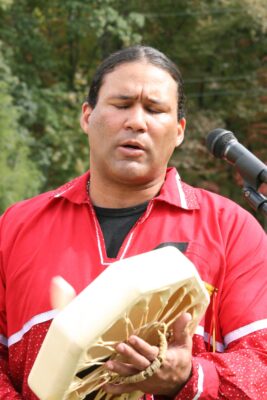
The theater is seen as a sacred space. It is where words, people, and experience of life intersect. It carries an elevated level of reverence and should be approached with care. When one steps into the sacred theater space it is to be done with carefulness, thoughtfulness and respect. It is where the sacred four directions come together on mother earth and under father sky centered from your own heart. For instance, I once was in a musical play titled,” Annie’s Got a Gun”. I played the character Wovoka. He was a Southern Paiute holy man during the time of U.S. western invasion. Wovoka had an encounter with Christianity. Wovoka had a vision to create the Ghost Dance. He wanted to help his people to be able to have strength and protection by practicing this dance. When I was doing this role, I often wondered how Wovoka felt. How was he so convinced that this dance would help his people. Secondly, I wondered if the audience, who had no idea of who Wovoka was, if they would understand what Wovoka was inspired to do. It felt at times that I was lost in the text, and movement that I was him. I could really feel his frustration. It is so mind blowing to think that simple shapes that form words on paper, supported by all the theatrics, could have that much power but they do.
I have had the privilege to participate in some traditional ceremonies, and I have experienced working in the theater for the last fifteen years, I have found it to be the most amazing instrument of expression. It can give an audience an insight into a deeper meaning of life, and it can change a person’s perspective and spirit. People come to the theater for many reasons, and they are all offered a glimpse of something that can be life changing.
My disclaimer, I want to say I am not a theater historian or anthropologist of theater and American Indian culture. I enjoy the art of theater and storytelling, and how it can transform lives and communities for the better. I understand the value in theater and how it can play its part in American Indian communities by reestablishing traditions and lessons that can be a foundation for living life. As an actor, educational cultural speaker, and artist I feel that theater is the purest and deepest connection to Life.
As I journey on, I encourage you to support American Indian theater, and get to know the amazing playwrights, phenomenal actors, and others who may be involved in an American Indian produced project. Theater has the power to change the mind, heart, and the world of anyone it touches by sharing the following tribal traditions: bravery, humility, honesty, truth, respect, love, and wisdom. These align directly with Native American ideology.
Lastly, in most tribal communities, there is no word for goodbye. We have words or gestures that generally mean, “until we meet again or see you soon,” Oon’eh.
So, I will say to you,
Oon’eh my readers…
I look forward to seeing you in the theater stage of life.